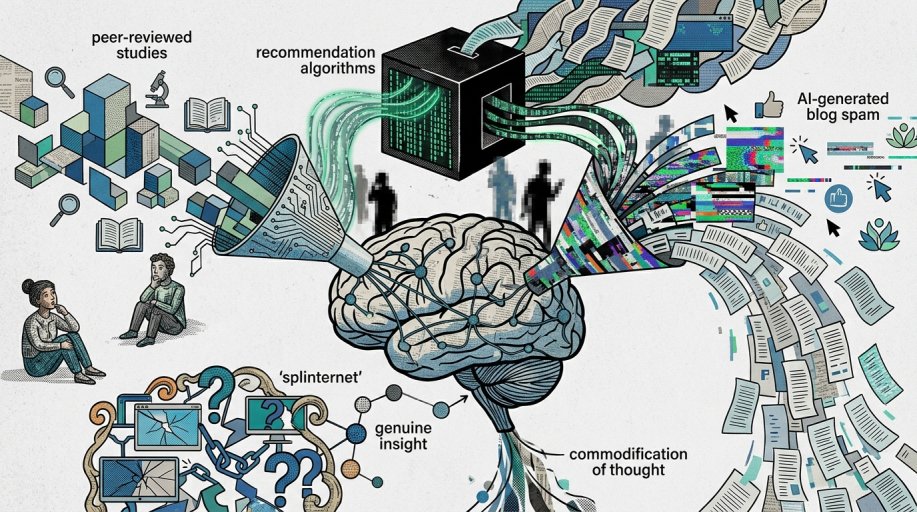
Mindfulness: Unlock Your Brain's Potential Spam
The cognitive wellness industry has a spam problem—and the machines have already won.
PLUS: The media's existential crisis, repackaged as self-care.
The thing you need to understand about the current wave of mindfulness content is that it's not really about mindfulness at all. It's about filling the algorithmic maw with something—anything—that looks like a legitimate article. I've spent the past week wading through the search results for "mindfulness" and "academic performance," and what I found wasn't a discourse. It was a factory.
It feels like we've reached a new, deeply cynical stage of the content apocalypse. The early AI-generated articles were obvious, clumsy, and often wrong. The current crop, however, is more insidious. They are syntactically correct, thematically on-brand, and utterly devoid of a single human thought. The business model revelation here is stark: if the value is in the information, not the writing, then people will care less that AI did most of the writing. We are testing that premise at scale, in real-time, with our mental well-being as the subject.
Following: The Human Voice, Drowning in Procedural Noise
PLUS: A legitimate theory of consciousness gets buried. PLUS: The Harvard study is ten years old.
Buried in the XML slurry are a few actual human artifacts. Psychology Today publishes an interview with psychiatrist Tom Froese on his "irruption theory," a nuanced argument that subjective experience can't be reduced to brain activity. A blog called Wisdom Quarterly cites a recent study in the Quarterly Journal of Experimental Psychology on how brief meditation improves learning from positive feedback. These pieces have a voice, a point of view, an argument.
They are also completely surrounded. The signal-to-noise ratio isn't just poor—it's catastrophic. For every one piece with a byline and a hypothesis, there are a dozen from spam sites. These sites don't have an editorial voice. They have a content template. The articles are structured identically: a generic headline, then a barrage of grammatically correct but semantically null sentences like "Travel experience 57 opens minds to diverse cultures" and "Business insight 76 emphasizes ethics, value creation, and long-term sustainable success over shortcuts."
I find myself asking a simple question: who is this for? The human reader is clearly an afterthought. This is content engineered for search engine crawlers, designed to trigger "E-A-T" (Expertise, Authoritativeness, Trustworthiness) signals by sheer bulk and thematic consistency. It's the splinternet of knowledge—a parallel web built for machines, indexed by machines, and increasingly, only readable by machines.
The Spam Farm Problem
The operational scale is what's breathtaking. The search results list at least eight distinct but identically structured sites all publishing near-identical articles on "The Role of Mindfulness in Enhancing Academic Performance" or "How Mindful Practices Improve Cognitive Function" within hours of each other on April 21, 2026.
This isn't a coincidence. It's an infrastructure. People familiar with the matter in the SEO industry describe these as "PBNs" or Private Blog Networks—interlinked clusters of websites built to manipulate search rankings. A single entity, or a single AI content-generation service, can spin up hundreds of these domains, populate them with variations on the same AI-generated text, and use them to backlink to a "money site" or simply to vacuum up ad revenue from long-tail search traffic.
The content is weaponized adjacency. It latches onto legitimate, high-intent search terms like "mindfulness for students" and suffocates the actual results with a wall of verbal packing peanuts. The user looking for help gets a page that says, "Inspirational thought 67 reminds us that obstacles are opportunities to grow stronger," followed by a widget for "Business insight 97." The experience is less like reading and more like being trapped in a motivational poster factory that's had a critical failure.
The Support System Failure
So where does the blame lie? The obvious culprits are the low-cost AI text generators and the mercenary SEO shops that use them. But the thing you need to understand is that this is a platform governance failure. Google's core product is organizing the world's information. Its search results for a foundational wellness topic are now a demonstrable, unusable mess. The company has spent years refining algorithms to fight "low-quality content," but the goalposts have moved. The new spam isn't keyword-stuffed gibberish; it's fluent, topical, and perfectly formatted.
It passes the old tests. The automated systems looking for "thin content" see 800 words. Those checking for relevance see the term "mindfulness" repeated. The linguistic models assessing fluency see coherent sentences. Google has vowed to prioritize "helpful content." But its definition of "unhelpful" is being rewritten in real-time by systems designed to mimic helpfulness without the intent. This is the bureaucratic violence of the attention economy, inflicted automatically.
The platforms that host this content—often generic WordPress installations with cheap templates—are complicit through indifference. The ad networks that place programmatic advertising against these pages fund the entire operation. The cycle is self-perpetuating and incredibly cheap to run. The marginal cost of generating the 15th article on mindfulness for MindNesters is effectively zero.
The Black Box of Consciousness, Optimized for Clicks
There's a grim irony here that Froese, the psychiatrist in the Psychology Today article, would appreciate. His "irruption theory" examines how subjective mental states genuinely influence behavior—the mind matters. The AI spam farm is the polar opposite: a system designed to eliminate subjective experience entirely, to produce behavior (clicks, engagement, ad revenue) through pure, automated procedure. It is the total reduction of meaning to mechanism.
When every inspirational thought is numbered and every travel experience is a variable slot in a template, we are not reading about mindfulness. We are witnessing its annihilation. The articles promise focus, resilience, and emotional regulation while actively degrading the informational environment required for any of those things. They are the cognitive equivalent of selling bottled water while poisoning the well.
So where does this all end? I've been asking sources that question all week. The optimistic view is that search engines will get better at detecting this new, fluent spam, perhaps by identifying the tell-tale pattern of templated variables or by further elevating known human brands. The pessimistic view—and the one that feels more accurate—is that this is the new normal. The frontier of the web will be an ever-expanding territory of synthetic text, marginally coherent and utterly transactional. The human web, the one with arguments and voices and mistakes, will retreat behind paywalls, newsletters, and closed apps.
We wanted machines to free us from drudgery. Instead, they are simulating the human activity of sharing wisdom, at an industrial scale, until the original becomes almost impossible to find. The practice of mindfulness, it turns out, begins with being able to find an article about it that was written by a person.
Not anymore.
Talk to us
Send tips, comments, and questions. We read everything, even if we can’t respond to all of it.